
Which bike carrier system is suitable for my motorhome?
What makes the different bike carrier systems different and which one suits you and your vehicle bestYou would like to Bicycle with you on your motorhome vacation and are wondering how to go about it? Fortunately, both motorhomes and campervans offer a number of practical options in the form of various bike carrier systems. To save you time-consuming research, we have listed the most important facts about the various bike carrier systems.
Exclusively for motorhomes: garage systems
A popular option for bicycle transportation, but one that is only suitable for Larger motorhomes with rear garage is internal transportation via the garage. This storage space offers plenty of room for storing your own bikes without the need for an external bike rack. Nevertheless, a certain Transport equipment otherwise friction damage can occur to the bike or the garage walls. You can secure your bikes, for example, with the help of Floor railsinto which the bicycles without front wheels are clamped, or with the help of Carriers on sledgesthrough which the wheels can be supported upwards or to the side. On some models, the rails are fixed, on others they can be extended, which makes loading and unloading even easier. If you only want to transport your bike in the rear occasionally, a good lashing system is also sufficient, in which your bike is securely fastened with a lashing strap.
Garage systems offer the advantage that bicycles and e-bikes can be transported out of sight and out of the weather - and for e-bike owners, they have the particular advantage that charging facilities can be installed here. However, the storage space for camping furniture, for example, is reduced with this variant.
For motorhomes and campervans: rear wall mounting
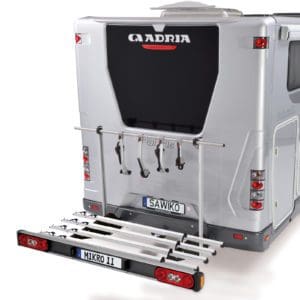
This variant is a popular solution for transporting bicycles in both motorhomes and camper vans. The bike rack is attached to the rear of the motorhome using self-tapping screws or a drill - usually on the tailgate or on the chassis. Special features of interest to you: Rear carriers have a low tare weight and a high payload. They can therefore carry a payload of up to 60 kilograms, which is sufficient for transporting an average of two heavy e-bikes or four regular bicycles. For vans, however, it is only 35 kilograms.
However, as the loading height can sometimes be quite high and often causes problems when charging heavier bikes (especially e-bikes), it is a good idea to look out for lowerable rails that can be brought to a comfortable height either by means of a hand crank or a motorized lowering system. This can also make the charging process much more convenient for regular bikes. Rear carriers offer the further advantage of being quick to remove with few tools and are also inexpensive. Disadvantages are a very narrow rail spacing from a number of three bikes and a high loading height if there is no lowering.

Chassis assembly
With this option, you don't need to worry about whether your bike carrier can hold your e-bikes, as chassis carriers allow you to transport payloads of up to 150 kg. This even makes it possible to carry a lighter scooter or motorcycle. In contrast to rear wall mounting, the low loading height also eliminates the problem of loading and unloading. Nevertheless, there are also ramps here that make it easier to push the bikes - and e-bikes in particular - upwards. Many bike carriers can be completely removed, and many manufacturers also offer suitable protective covers to protect the load. However, this carrier system comes at a price - and is quite heavy. In addition, frame extensions and the electrics for additional lighting have to be fitted. An additional air spring for the rear axle is also recommended. Important: This variant should always be fitted by an expert.
Towbar carrier
If you have a towbar, you can use a very simple and therefore popular bicycle carrier variant and mount a bicycle carrier on the towbar. This can be quickly and easily screwed or clamped onto it and just as quickly unscrewed again - which is why an expert is not necessarily required for this variant.
However, it should be noted that the towbar carrier has its own lighting and license plate, as the lighting and license plate are covered by the motorhome or campervan. The purchase costs here are in the medium range - however, the drawbar load - and therefore also the fuel consumption - increases significantly. In order to still be able to open the doors, a fold-down carrier must also be fitted to vans.
For campervans: door assembly and hinge assembly
As you have now learned, there are also a variety of options for mounting a bike rack on a camper van. The door mounting and hinge mounting options are particularly suitable for this.
For door mounting, the carrier is hooked onto the rail that is attached to the right-hand rear door. The advantage of door mounting is that it is relatively inexpensive, has a low dead weight and can be removed quickly after initial installation. However, it only allows a load capacity of up to 35 kilograms and the door and hinges are subject to heavy loads, which is why it is not suitable for transporting e-bikes. This variant also blocks the view out of the window.
For e-bike transport, the carrier can be mounted on the chassis or directly on the hinges. The latter variant works by attaching a bike carrier to the screw bolts of the door hinges. However, these must be unlocked before they can be swung away. Here, higher payloads of up to 60 kilograms are possible and the doors themselves are not loaded. However, they are more expensive and heavier than door carriers.
Alternatives to the bike rack
If you don't necessarily need your normal bike or e-bike on vacation and would like to save space and weight, then our practical folding bikes can be the perfect alternative.
Find out here what else you need to consider when taking bicycles with you. Have fun on your next camper trip with a bike.
Pictures: Thule Sweden AB / ALOIS KOBER GMBH